The Grand Rapids Home Inspection Blind Spot Buyers Don't Budget For
August 27, 2026
August 27, 2026
A buyer under contract on a 1922 bungalow near Wealthy Street does the right things. She hires a licensed inspector. She gets a radon test. She reads the seller's disclosure statement twice. Three weeks after closing, a toilet in the basement starts gurgling every time the washing machine drains, and a plumber's camera finds a collapsed section of clay pipe fifteen feet from the house, choked by a silver maple root ball that has been growing into it since before she was born.
Nothing on her inspection report mentioned it. Nothing on the seller's disclosure form did either. That is not because anyone hid anything. It is because the sewer lateral, the pipe that carries waste from the house to the street main, sits outside the boundary of what a standard home inspection covers and often outside what a seller even knows to disclose. In a city where a meaningful share of the housing stock predates 1930, that gap is worth understanding before you write an offer, not after a toilet starts gurgling.
A general home inspection in Michigan walks the roof, the foundation, the electrical panel, the furnace, and the plumbing fixtures inside the house. It does not send a camera underground. That is a separate service, commonly called a sewer scope, and it is the only reliable way to see the actual condition of the pipe running from the house to the city main.
The distinction matters more in Grand Rapids than in a newer suburb because of what that underground pipe is usually made of. Homes built from the city's early growth years through the mid-twentieth century were commonly connected with clay tile, cast iron, or orangeburg pipe. All three have a functional lifespan, and properties with original lines from that era are often working with pipe that is at or past the end of it. Add Michigan's freeze-thaw cycle and the region's clay-heavy soil, and you get a second, compounding problem: ground movement that shifts joints and creates low spots, called bellies, where water and debris collect instead of draining.
Then there is the tree canopy, which is part of what makes these neighborhoods desirable in the first place. Mature maples, oaks, and elms send roots toward any source of moisture and nutrients, and a hairline crack or loose joint in an old clay or cast-iron line is exactly the kind of opening they exploit. Once inside, roots grow quickly enough to turn a slow drain into a full backup within a season.
This is not a citywide risk in equal measure. It concentrates in the neighborhoods with the oldest continuous housing stock.
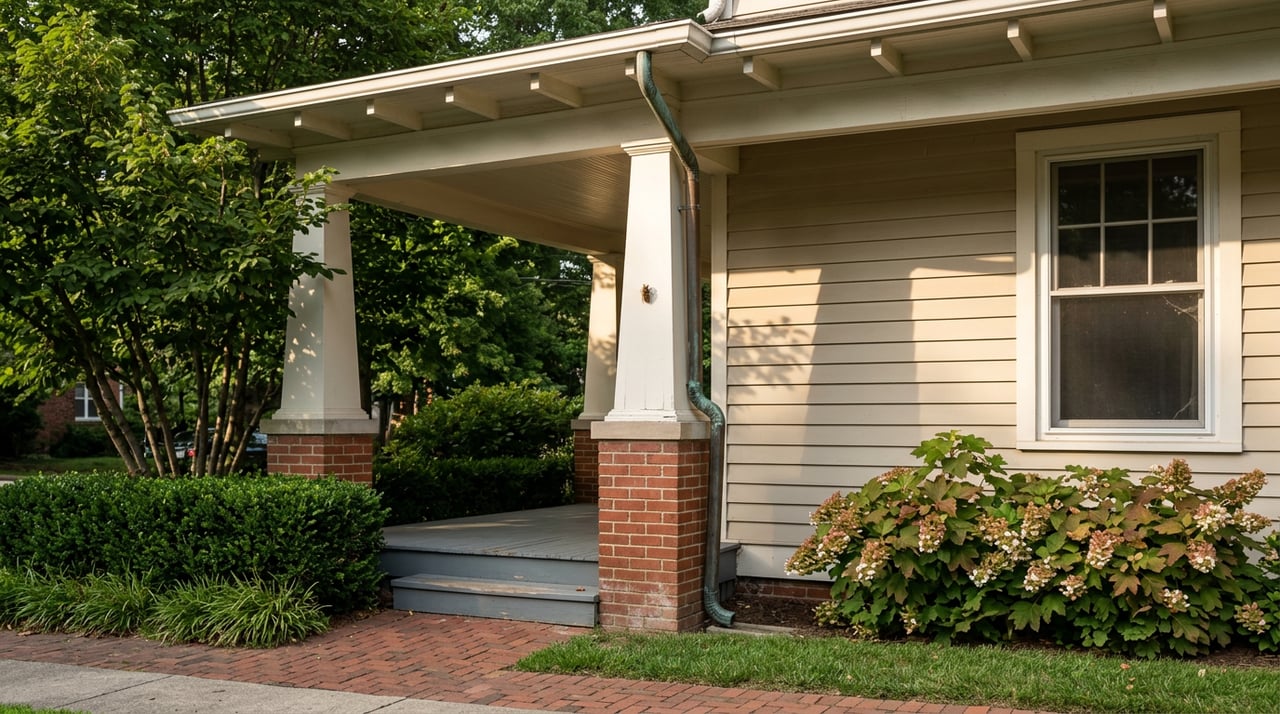
Heritage Hill, adjacent to downtown and one of the largest urban historic districts in the country, holds roughly 1,300 homes dating back to the 1840s, with the bulk of the district built out between the 1880s and 1920s. Eastown's housing stock runs largely 1910 to 1930. Ottawa Hills was platted as one of the city's first planned residential neighborhoods in the 1920s, with most homes built between 1920 and 1940. Cherry Hill, just south of Heritage Hill, carries a concentration of Victorian-era homes dating to the late 1800s. On the west side, the streets around John Ball Park and Stockbridge share the same older-pipe profile, with the added complication of mature street trees planted close to the original lateral runs.
None of that is a reason to avoid these neighborhoods. It is a reason to treat the sewer lateral as its own line item in due diligence rather than an afterthought, the same way you would already budget separately for radon testing.
What a camera inspection actually shows:
A camera inspection is non-invasive, typically takes under an hour, and produces footage you can review yourself rather than take on faith.
Buyers sometimes assume that if a sewer problem existed, it would have shown up on the seller's disclosure statement. Michigan's Seller Disclosure Act, in place since 1993, requires sellers to answer a standardized set of questions about the property's known condition in good faith. But the standard itself is the limit. The form exists to capture what the seller actually knows, and it explicitly acknowledges that sellers have not conducted inspections of generally inaccessible areas, historically meaning things like the foundation or roof, but the same logic extends to a pipe buried several feet underground that has never backed up during their ownership.
That is the quiet part of this whole issue. A seller who has lived in a home for eight years without a single backup has no reason to check "yes" to a sewer problem, because as far as they know, there isn't one. A lateral can be three-quarters blocked by root intrusion and still drain well enough that nobody notices until the day it doesn't. Disclosure protects against sellers hiding things they know. It does nothing for the things nobody involved has ever looked at.
Older Grand Rapids homes carry a related and separate consideration: the material of the water service line coming into the house. Homes built before 1960 are the most likely to have been connected with lead or galvanized supply lines, and Michigan's disclosure expectations post-Flint have moved toward including known service line material and any participation in a municipal replacement program as part of what sellers should share.
Grand Rapids has been actively working through this. The city's Lead Line Replacement Program has been replacing lines since 2017, and its public Lead Water Service Line Map lets anyone search a specific address to see what the city's historical records show for that property, updated as new information comes in. The city has also secured a $5.1 million EPA grant for private lead service line replacements, with a 10 percent local match. Replacement has generally been done at no cost to the property owner, and a federal rule change in October 2024 pushed the EPA to tighten the timeline cities have to complete this work, so pace has picked up in the years since.
This runs alongside, not instead of, the older federal requirement that sellers of any home built before 1978 provide an EPA-approved lead paint pamphlet, disclose known lead paint hazards, and give buyers at least ten days to arrange their own lead inspection before that right is waived. Two different lead questions, two different systems, one general rule for anyone buying a pre-1978 Grand Rapids home: check both, and don't assume the disclosure form covers what the seller was never in a position to know.
If you are buying an older home in Heritage Hill, Eastown, Ottawa Hills, Cherry Hill, or the Westside neighborhoods near John Ball Park, build a sewer scope into your inspection contingency the same way you would a radon test. It is a modest cost measured against the price of an emergency excavation, and it gives you leverage to negotiate a repair credit before you own the problem outright. Ask your agent to pull the property's history on the city's Lead Water Service Line Map before you write the offer, not after.
If you are selling one of these homes, get ahead of both issues rather than letting a buyer's inspector find them first. A documented, camera-verified sewer line and a clear answer on service line material read as evidence of a well-maintained home, and they remove two of the most common places a deal gets renegotiated in the final week before closing.
Does a sewer scope replace a standard home inspection? No. They cover different systems entirely. A general inspection evaluates the house itself. A sewer scope is the only way to see the condition of the underground lateral connecting the house to the street main, and it has to be ordered separately.
Do sellers have to disclose a lead service line in Michigan? Sellers are expected to disclose what they actually know about the service line material and any prior water testing or participation in a replacement program. If a seller genuinely does not know the material, checking unknown on the disclosure form is permitted and is not the same as hiding a defect.
Older homes are why people move to these neighborhoods in the first place, the tree canopy, the architecture, the walk to Wealthy Street or Cherry Street. None of that is a reason to skip the due diligence that era of housing actually requires. If you are weighing a purchase or a sale in one of Grand Rapids's older neighborhoods and want a second set of eyes on what to check before you're under contract, Lindsey Eppink is happy to walk through it with you. You can also browse current homes and community details on the Grand Rapids neighborhood page or start a conversation any time through the contact page.
Stay up to date on the latest real estate trends.



Experience a thoughtful, client-focused approach backed by local expertise, responsive communication, and a genuine passion for helping people feel at home.